Track inventory, cost and profiton every unit you resell.
Navar is inventory management software for people who resell sneakers and trading cards. It keeps the cost basis of every unit, prices what you hold against the live market, and turns a stock list into a link buyers can reserve from.
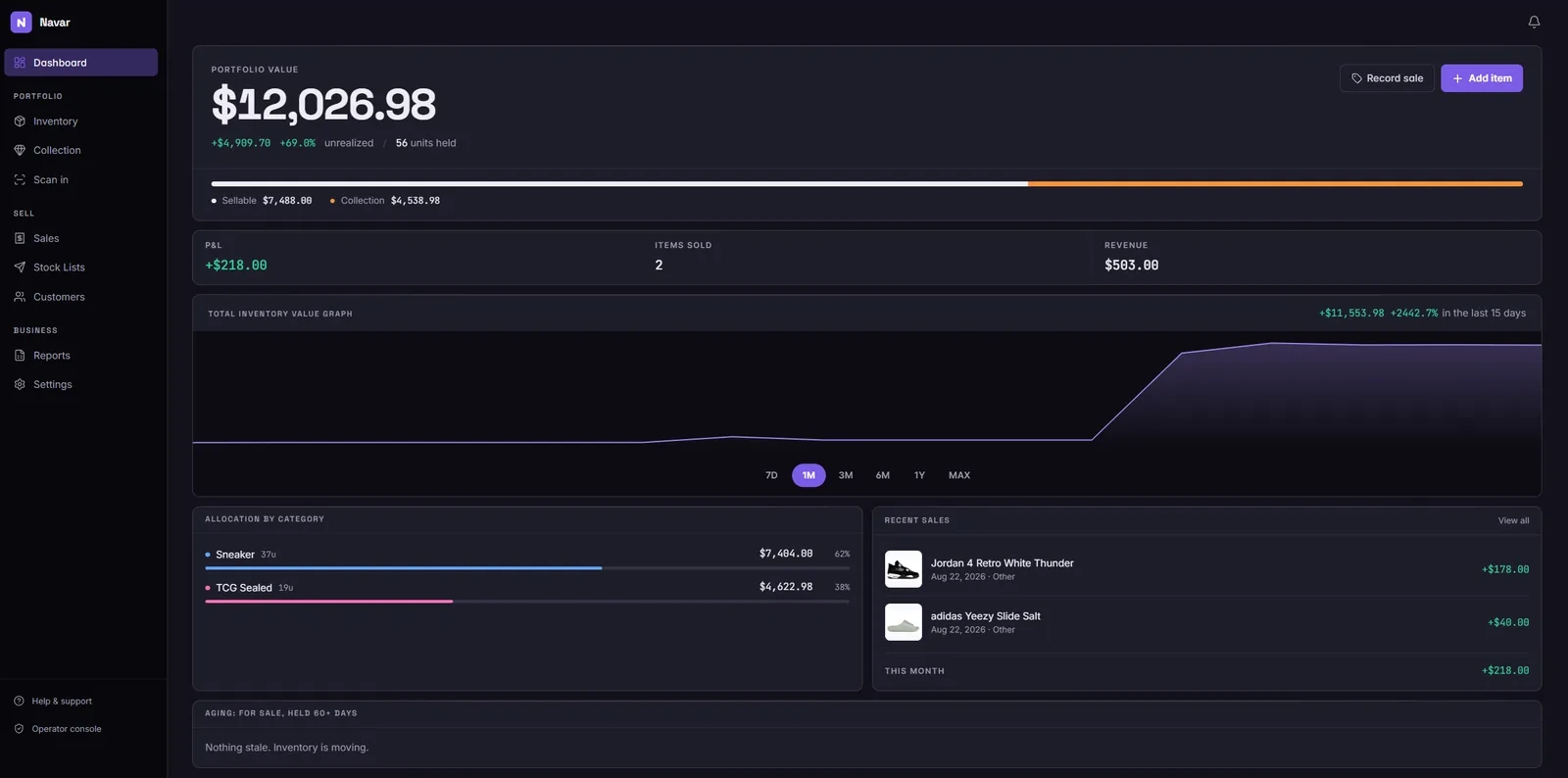
- Cost basis
- Per unit, landed
- Market value
- Refreshed daily
- Stock in
- Barcode or CSV
- Priced from
- StockX, eBay, TCGplayer
How it works
Adding stock, pricing it, selling it
Add what you own
Scan a barcode with your phone, search the catalog, type an item in by hand, or import the sheet you already keep. Nothing joins your inventory until you confirm it.
See what it is worth
Every unit shows what you paid, what it is worth today, and where that price came from. The portfolio total updates as those prices refresh.
Sell it and record the sale
Share a priced list, take claims and offers, then record the sale with its fees and shipping so the profit figure is the money that reached you.
Intake
Scanning stock in
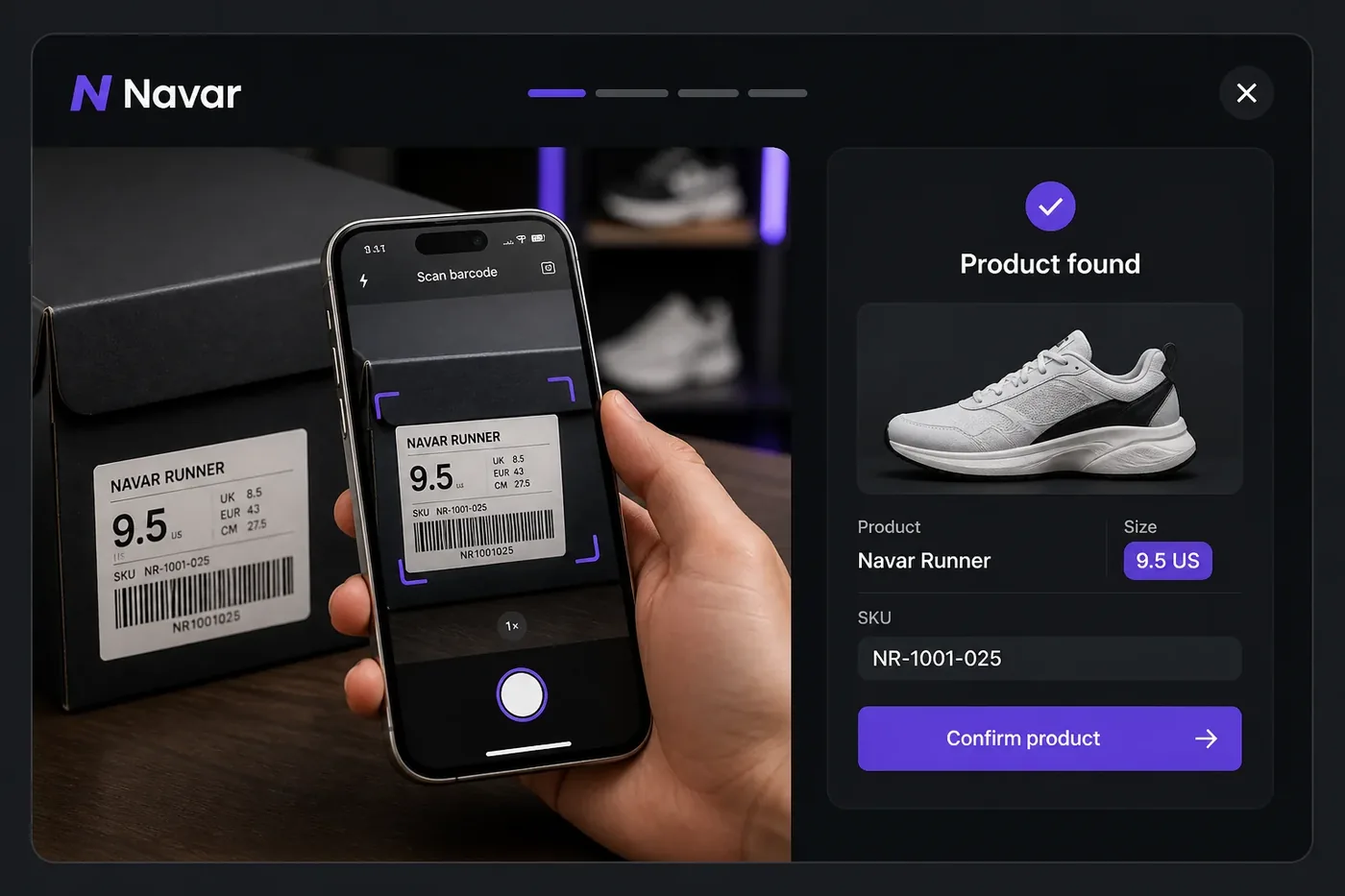
The camera reads the codes printed on shoe boxes, clothing tags and sealed product: UPC-A, UPC-E, EAN-13, EAN-8, Code 128, Code 39 and ITF. Navar looks the code up, shows what it is going for, and files the unit with what you paid.
- The price appears before you buy, so a scan in a shop is a check on the deal.
- Typing the digits in runs the same lookup when there is no camera to hand.
- It installs to a phone home screen, so the scanner opens in one tap.
Selling
Stock lists buyers can reserve from
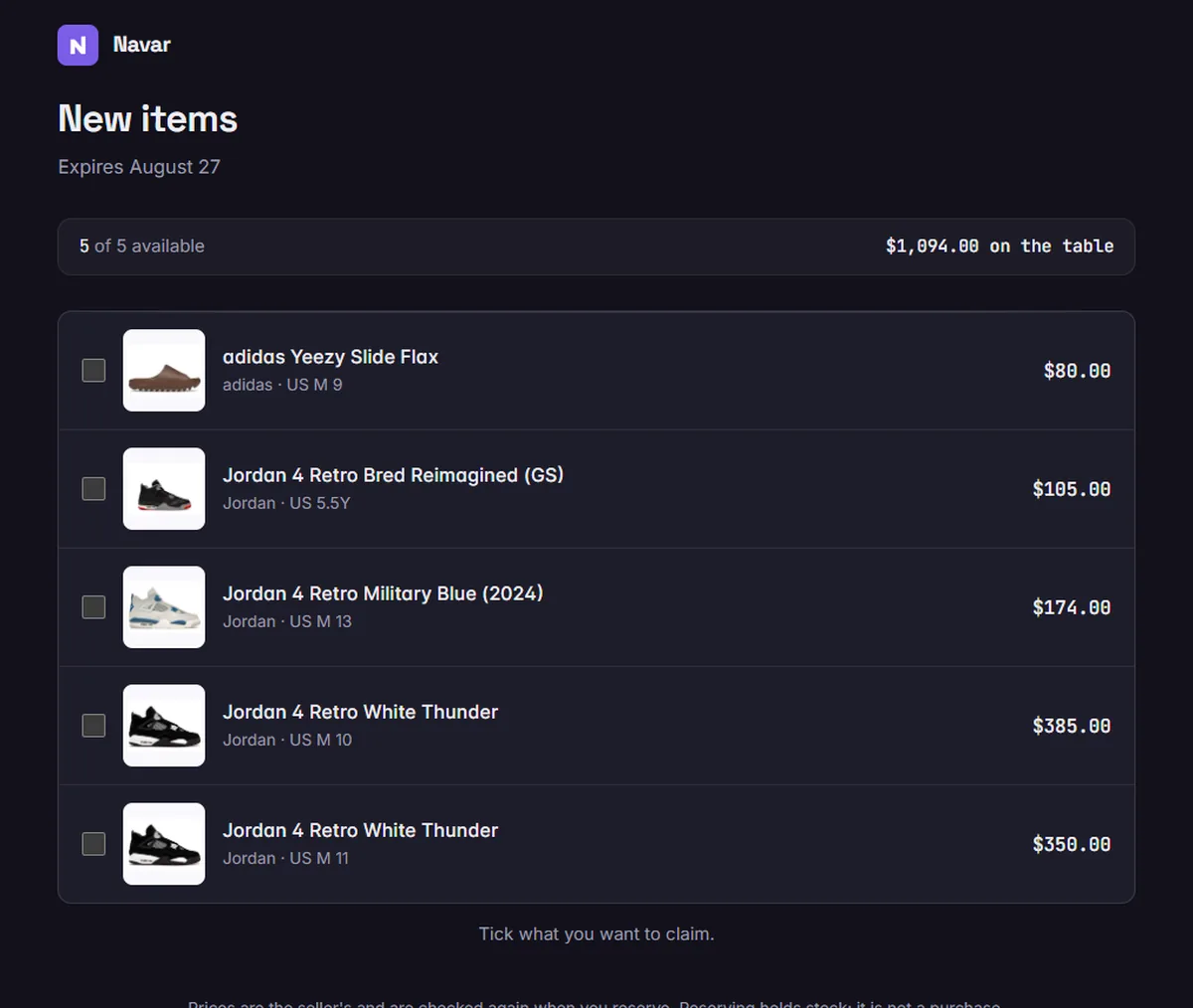
Pick the units you want to move, choose how they are priced, and send a link to a group chat. Buyers claim exact units or make an offer without creating an account.
- A claim takes the unit off every other list you have shared, so the same pair cannot go twice.
- Each claim opens a thread you accept, counter or decline, and accepting raises the invoice.
- Money never moves through Navar. A claim sets stock aside, and you settle the sale yourself.
Features
What Navar does
Cost basis per unit
One row per item, not per style. Purchase price, shipping in, sales tax, grading and authentication fees roll into a landed cost, so margin is measured against what you actually paid instead of the sticker on the box.
Barcode scanning
Point the camera at a barcode and Navar matches it to the catalog, pulls the current market price and files the unit. You never type a style code, and there is no scanner hardware to buy.
Daily market prices
Prices come from StockX, eBay and TCGplayer and refresh once a day, so portfolio value is today's number. Every figure carries the date it was observed, so you always know how old the number you are pricing against is.
Shareable stock lists
Send a priced, live link to a group chat. Buyers claim or make an offer, the unit comes off every other list the instant it goes, and the claim opens a thread you accept, counter or decline. Accepting raises the invoice.
P&L, cost of goods and expenses
Realized profit per sale after platform fees and shipping, monthly profit and loss, recurring costs like storage and subscriptions, and a CSV export for when it is time to hand a year to an accountant.
CSV import and export
Bring a CSV from Sire, Collectr or your own sheet. Navar maps the columns, collapses a size run into one product, and refuses an import that would land stock with no cost rather than quietly reporting it as pure profit.
Vs a spreadsheet
Navar next to a spreadsheet
Adding a pair to stock
In a spreadsheet: Type the style, size, cost and date into a new row.
In Navar: Scan the box and confirm what you paid.
What it is worth today
In a spreadsheet: You look it up yourself, one item at a time.
In Navar: Prices refresh once a day and carry the date they were seen.
Selling the same pair twice
In a spreadsheet: Nothing in the file stops you.
In Navar: A claimed unit leaves every other list the moment it goes.
Sending stock to a buyer
In a spreadsheet: A screenshot, or a copy of the file with your costs in it.
In Navar: A live link they can claim from or make an offer on.
Profit after fees
In a spreadsheet: A formula you wrote and have to maintain.
In Navar: Fees and shipping come off the sale as you record it.
Handing a year to an accountant
In a spreadsheet: The file is the record.
In Navar: CSV export of sales and of inventory, from Reports.
Who it is for
Sneakers, cards and personal collections
Sneaker resellers
A size run is one product with a unit per size. Track pairs by style code and size, price them against StockX and eBay, and print label sheets for the ones sitting in a storeroom.
Scanning and labelsCard and TCG sellers
Graded slabs are tracked by cert number and grade, raw cards by set and condition, and sealed product by SKU. A slab is priced against slabs of the same grade rather than lumped in with the raw card.
Where card prices come fromAnyone holding a collection
Inventory is what you plan to sell and Collection is what you are keeping, and they are separate books. Both count toward the portfolio total, and a grail can never end up on a list you send a buyer.
Inventory vs collectionPricing
What it costs
Nothing, with every part of the product switched on. The terms are what make that a commitment rather than a plan: a fee could only ever apply to an account that was told about it and accepted it, and nothing in them lets an existing account start being charged.
$0forever
- Unlimited items, sales, customers and stock lists
- Barcode scanning, CSV import and CSV export
- Daily market prices from StockX, eBay and TCGplayer
- Navar never asks for card details and stores no payment method
What does Navar track?
Individual units of inventory: what each one cost to acquire, what it is worth now, where it is in its life (held, listed, reserved, sold) and what it earned when it went. It also keeps a separate book for a personal collection, so grails are valued alongside stock without ever appearing on something you send a buyer.
Does it work for both sneakers and trading cards?
Yes. Sneakers are tracked by style code and size, graded cards by cert number and grade, raw cards by set and condition, and sealed product by SKU. Category is a filter inside each screen rather than a separate app.
Where do the market prices come from?
StockX and eBay for sneakers and graded slabs, TCGplayer for raw and sealed cards, refreshed once a day. Anything the catalog cannot price can be valued by hand, and an item with no market value is shown at cost rather than guessed at.
More on pricingWhich barcodes can it read?
The ones printed on shoe boxes, clothing tags and sealed product: UPC-A, UPC-E, EAN-13, EAN-8, Code 128, Code 39 and ITF. Typing the digits in does the same lookup as scanning them.
Scanning answersCan I move data in from a spreadsheet?
Yes. CSV import reads exports from Sire and Collectr as well as an ordinary sheet, and shows you the column mapping before anything is written.
How import worksDo I have to install anything?
No. Navar runs in a browser. On a phone you can add it to the home screen and it opens like an app, which is also what the camera scanner needs, and there is nothing to download from an app store.
Put it on your phoneDoes Navar take payment from buyers?
No. It is a record-keeping tool, not a marketplace or a payment processor. Buyers can claim a unit and agree a price with you through the list, and the money moves between the two of you exactly as it does now.
Read the termsIs it free?
Yes, and it stays free. There is no subscription, no trial that converts and no stored payment method. The terms go further than a marketing page can: a fee could only ever apply to an account that was told about it and accepted it, and nothing in them lets an existing account start being charged.
Read the termsCan I get my data back out?
Yes. Reports has a CSV export for inventory and one for sales, and you can delete the account and everything in it from settings. Keeping your own copy before a bulk edit is a good habit.
How exports workWhat currency does it use?
You pick one display currency for the account, from nine that include the US dollar, euro, pound, Canadian and Australian dollars and the yen. It re-labels amounts rather than converting them, because there is no exchange-rate feed behind it and a guessed rate would quietly corrupt every profit figure you have.
How is this different from a spreadsheet?
A spreadsheet cannot price itself, cannot stop you selling the same pair twice, and cannot be sent to a buyer as a live list. Navar keeps the cost arithmetic a sheet does and adds the parts a sheet has no way to do.
Start tracking your stock
Import a CSV of what you already track, or scan the first box in.